Lessons learned from COP 17 in Yerevan
One of the major developments at this COP has been the release of the UN CBD Secretariat's “State of Biodiversity Action” report, drawing together evidence from countries' 7th national reports and other sources to assess collective progress towards the Kunming-Montreal Global Biodiversity Framework. The report emphasizes a global problem: countries are taking action and making commitments, but monitoring and reporting progress is difficult. Monitoring systems to track the effectiveness of conservation measures and identify areas for investment are lacking.
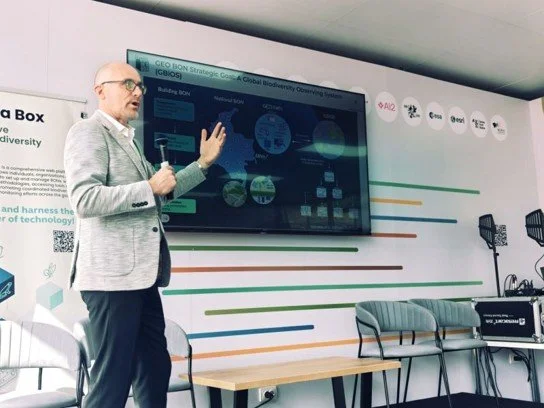
Andy served as one of the hosts of the Data to Action Pavilion. The pavilion was convened by GEO BON, Group on Earth Observations (GEO), GBIF: The Global Biodiversity Information Facility, Smithsonian Institution, University of Zurich, in collaboration with our partners and sponsors, Ai2, Esri, European Space Agency - ESA, Quebec Centre for Biodiversity Science, and made possible through the generous contribution of the NOMIS Foundation.
I was delighted to serve as one of the hosts of the Data to Action Pavilion. The pavilion was convened by GEO BON, Group on Earth Observations (GEO), GBIF: The Global Biodiversity Information Facility, Smithsonian Institution, University of Zurich, in collaboration with our partners and sponsors, Ai2, Esri, European Space Agency - ESA, Quebec Centre for Biodiversity Science, and made possible through the generous contribution of the NOMIS Foundation.
GEO BON is building the BON in a Box platform to convert nature data into Essential Variables (EVs for biodiversity, impact, and NCP), and enabling the calculation of indicators needed to monitor and report progress towards biodiversity targets of the UN CBD’s KM-GBF by 2030.
I chaired two sessions on BON in a Box, a tool for implementing the Protected Connected Area index in Guinea. The company, Habitat, in collaboration with GEO BON, has helped implement this index to estimate connectivity for Guinea’s protected-area network. This is an example of data-driven action for biodiversity.
Our goal in the next few years is to support efforts to mainstream biodiversity monitoring knowledge so that it is more accessible, scientifically robust, and useful for decisions at all levels. This, we will do in large part in my role as co-chair of the IPBES Monitoring Assessment, to be presented to IPBES member states at IPBES 13 in November 2027.